
Of all the events I have helped produce, the Ginormous Pumpkin Regatta is the one I am most proud of.
For approximately six years, we transformed Oquirrh Lake in Daybreak into one of the most unusual fall celebrations in Utah. The event routinely attracted between 6,000 and 8,000 people, along with coverage from three local television news stations.
It was a celebration of the fall season with a whole lot of whimsy, wackiness, and residents walking home saying:
“I cannot believe that happened in our neighborhood.”
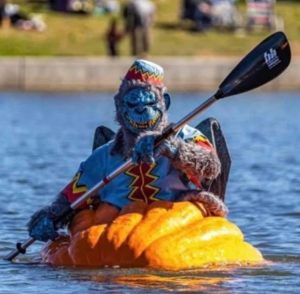
The basic premise was already ridiculous.
Growers carved out enormous pumpkins, some weighing close to 1,000 pounds. Participants climbed inside, often dressed as Scooby-Doo, flying monkeys from The Wizard of Oz, superheroes, or other improbable characters, and raced one another across the lake.
The goal was to outpaddle the other competitors and reach the finish line first. Of course, sometimes the winner was simply the pumpkin that did not take on water.
It was strange, visually irresistible, and unlike anything most people had ever seen.
It also created a problem.
Once you dramatically overdeliver with a wacky and engaging event, how do you up your game the following year?
I regularly challenged our staff with a simple standard. If we pulled out the file from the previous year and essentially produced the same event again, we had earned an automatic C.
The old file could provide the foundation. It reminded us what worked, what failed, which vendors to contact, and how many barricades, radios, volunteers, tables, and portable restrooms we needed.
But repeating last year’s event was not the same as improving it.
Every year, we had to ask what we could add, expand, improve, or make even more memorable.
Fortunately, our team kept finding answers.
Before the Race Comes the Growing
Many people ask about the science behind growing a giant pumpkin.
That may be a subject for another blog.
In short, it becomes a part-time job.
Success starts with genetics, but it also depends on the right soil, the right sunlight, carefully controlled moisture, pest control, the right additives, and a whole lot of dirt underneath your fingernails.
Many growers begin as early as April or May, starting seedlings in their garages and caring for them through a growing season that may not end until late September.
It requires an equal measure of dedication, thought, hard work, studying, and networking with the wonderfully quirky community of ginormous pumpkin growers.
Much like horse racing, genetics matter. It is not impossible to grow a ginormous pumpkin from a seed purchased at a typical home and garden store, but it is extremely difficult.
Serious growers track the lineage of their seeds and seek proven genetics from pumpkins that have already reached extraordinary sizes.
Some seeds can sell for thousands of dollars, but that is not necessary for someone entering the hobby. In fact, spending that kind of money as a first-year grower would probably be a waste.
There is a great deal to learn before premium genetics become the limiting factor.
The Science of Choosing a Racing Pumpkin
What many people do not realize is that there is also a bit of science involved in choosing the right pumpkin for the race.
Bigger is not always better.
If the pumpkin is far too large, the paddler must move a tremendous amount of weight across the lake. If it is too small, it can become extremely unstable. Once the pumpkin tips or begins taking on water, the race is essentially over.
Through years of trial and error, we developed what seemed to be the ideal formula:
The pumpkin should weigh approximately three times as much as the paddler.
Someone could certainly enter the regatta with a 300-pound pumpkin, but the person climbing inside should probably weigh less than 100 pounds.
By that calculation, my ideal racing pumpkin would be somewhere around 550 pounds.
I am not sure anyone should take racing advice from me, however. I paddled in the regatta for eight consecutive years and lost every single time.
Cardboard Boats and Spectacular Failure
One of the more obvious additions was a cardboard boat race.
The concept was simple. Teams built boats primarily from cardboard and tape, climbed inside, and attempted to race across the lake.
We quickly learned that the crowd was considerably more interested in the boats capsizing than in which team actually won.
A well-built cardboard boat quietly completing the course received polite applause.
A badly designed boat folding in half and depositing its crew into the lake received a roar from thousands of people.
Sometimes failure is the entertainment.
Dropping a Thousand-Pound Pumpkin
At the end of the regatta, we faced another practical question.
What do you do with a thousand-pound pumpkin after it has been carved out, raced across a lake, and become completely waterlogged?
You could haul it away quietly.
Or you could raise it approximately 40 feet into the air with a forklift and drop it in front of a cheering crowd.
We chose the second option.
The resulting explosion of pumpkin was messy, unnecessary, and completely appropriate for the event.
The Mascot Regatta
Costumed racers were already part of the experience, but one year we decided to take the idea further.
We invited mascots from local universities and professional sports teams throughout the Salt Lake Valley to compete in their own regatta.
Watching oversized mascots attempt to climb into pumpkins, balance themselves, and race across the lake was every bit as chaotic as it sounds.
It was a bit of a riot.
Letting the Audience Climb Inside
After the first couple of years, we realized that people did not want only to watch the regatta.
They wanted to experience it.
Part of that was curiosity. Part of it was the opportunity to capture the perfect photograph or Instagram moment.
After the official race ended and the trophy had been raised, we began lining people up along the dock and allowing them to climb inside a pumpkin and paddle a short distance around the lake.
Anyone who has carved a pumpkin knows that the inside can become a little soupy.
Now imagine sitting waist-deep inside one after it has spent the afternoon floating in a lake.
People still lined up for the opportunity.
Witches and Warlocks on Paddleboards
Daybreak is built around a 60-acre lake and has a strong paddleboarding culture. One of the largest recreational groups in the community was the paddleboard club.
We invited members of the club to participate in a witches and warlocks paddleboard race in front of approximately 5,000 spectators.
They arrived in costumes and raced across the lake as witches, warlocks, and other fall characters.
Once again, it delivered.
The addition worked because it was not random. It connected the event to something residents already loved and gave a familiar community activity an unexpected seasonal twist.
The Porta-Potty Epiphany
The strangest addition began early one Monday morning.
We received a report that a portable restroom had been pushed into the lake. A couple of middle-aged kids apparently thought it would be funny.
I will not go into too much detail about what was involved in recovering the unit.
But somewhere during that process, I had an epiphany.
These things float.
We contacted our portable-restroom supplier, hooked up a trailer, and visited what can only be described as a porta-potty graveyard.
Yes, that is apparently a thing.
We selected several retired units and subjected them to a thorough process of cleaning, scrubbing, sanitizing, and heavy bleaching.
Then we attempted to launch them.
They floated surprisingly well.
They just did not float for very long.
We discovered that years of use had left plenty of small openings where water could enter. That led to a trip to Home Depot and the purchase of several tubes of caulk.
After sealing the units and making a few additional adjustments, we were ready.
Soon afterward, what we believe was the first porta-potty boat race on the planet commenced in front of approximately 5,000 cheering spectators.
It was loud. It was ridiculous. It was slightly horrifying.
And it worked.
Last Year’s Success Is Only the Starting Point
The Ginormous Pumpkin Regatta taught me that a successful event can create its own challenge.
Once people have been surprised, they expect to be surprised again.
Over time, similar pumpkin regattas began appearing in communities around the country. Giant pumpkin racing even found its way onto an episode of The Bachelor.
It may be a little self-serving to suggest that our event helped inspire some of those races, but I suppose imitation is the sincerest form of flattery.
The idea was no longer unusual simply because people were climbing into giant produce and racing across a lake.
We had to keep finding new ways to elevate the experience.
You cannot simply pull out last year’s checklist, change the date, contact the same vendors, and assume the audience will respond with the same enthusiasm.
The operational file matters. It helps preserve what worked, correct what did not, and prevent the staff from reinventing every logistical detail.
But the creative file should never be closed.
Each year, the question was not whether we could reproduce the event.
It was whether we could give residents another experience that made them look at their neighborhood and say:
“I cannot believe that happened here.”
Some years that meant cardboard boats.
Some years it meant mascots, witches, giant pumpkin drops, or hundreds of residents climbing into a cold and soupy pumpkin.
And one year, it meant discovering that with enough bleach, caulk, and questionable judgment, even a porta-potty could become a boat.
For additional news coverage see the South Jordan Journal
Watch video from the Ginormous Pumpkin Regatta on Youtube